Melissa gave the Tea Talk seminar in the Geography Department at the University of Oregon on 2.20.2020. What a great department!

Shelby was selected as a NEON Early Career Scholar!
Shelby Weiss was selected as a NEON Early Career Scholar for ESA 2020 in Salt Lake City, Utah. Look for her at ESA!

Our new paper featured in Science X Daily

New lab publication about wildfire in the west
Here we show that, while there is a strong negative feedback for very short reburning intervals throughout wildland forests of the Western US, that feedback weakens after 10-20 years. Also, the relationship between reburning intervals and drought diverges depending on location, with coastal systems reburning quicker (e.g., shorter interval between fires) in wetter conditions and interior forests in drier. This supports the idea that vegetation productivity – primarily fine fuels that accumulate rapidly (<10 years) – is of primary importance in determining reburn intervals.

Buma B, SA Weiss, K Hayes and MS Lucash. 2020. Wildland fire reburning trends across the US West suggest only short-term negative feedback and differing climatic effects.
Accepted to Environmental Research Letters doi.org/10.1088/1748-9326/ab6c70
Finishing up your PhD or Postdoc this winter or spring? Join our lab!
Want details about the postdoc opening on our Siberia project? Click here. We start reviewing applications on 1/6/20.
Shelby, Jannike, and Melissa are headed to AGU!
We are presenting posters at #AGU2019 about our work in Alaska.
Details about all the talks and posters associated with the ReburnsAK project can be found here: https://www.reburnsak.com/blog

AFE talks in Tucson
Melissa and Shelby co-authored several talks at the AFE (American Fire Ecology) conference in Tucson, Arizona from Nov 18-22, 2019:
Negative feedbacks among multiple disturbances in north-central Minnesota (Lucash, Scheller, Gustafson, and Sturtevant
Continued repeat burning in the boreal causes continued ecosystem transformation (Hayes, Buma, Lucash, Weiss)
Rates of short-interval fires increasing across the U.S. West (Buma, Hayes, Weiss and Lucash)

AFE venue in Tucson, AZ. It was gorgeous!
New lab publication in Ecosphere
Widespread severe wildfires under climate change lead to increased forest homogeneity in dry mixed‐conifer forests.
Brooke Cassell, RM Scheller, MS Lucash, MD Hurteau, and EL Loudermilk. 2019.
Ecosphere 10( 11):e02934. 10.1002/ecs2.2934
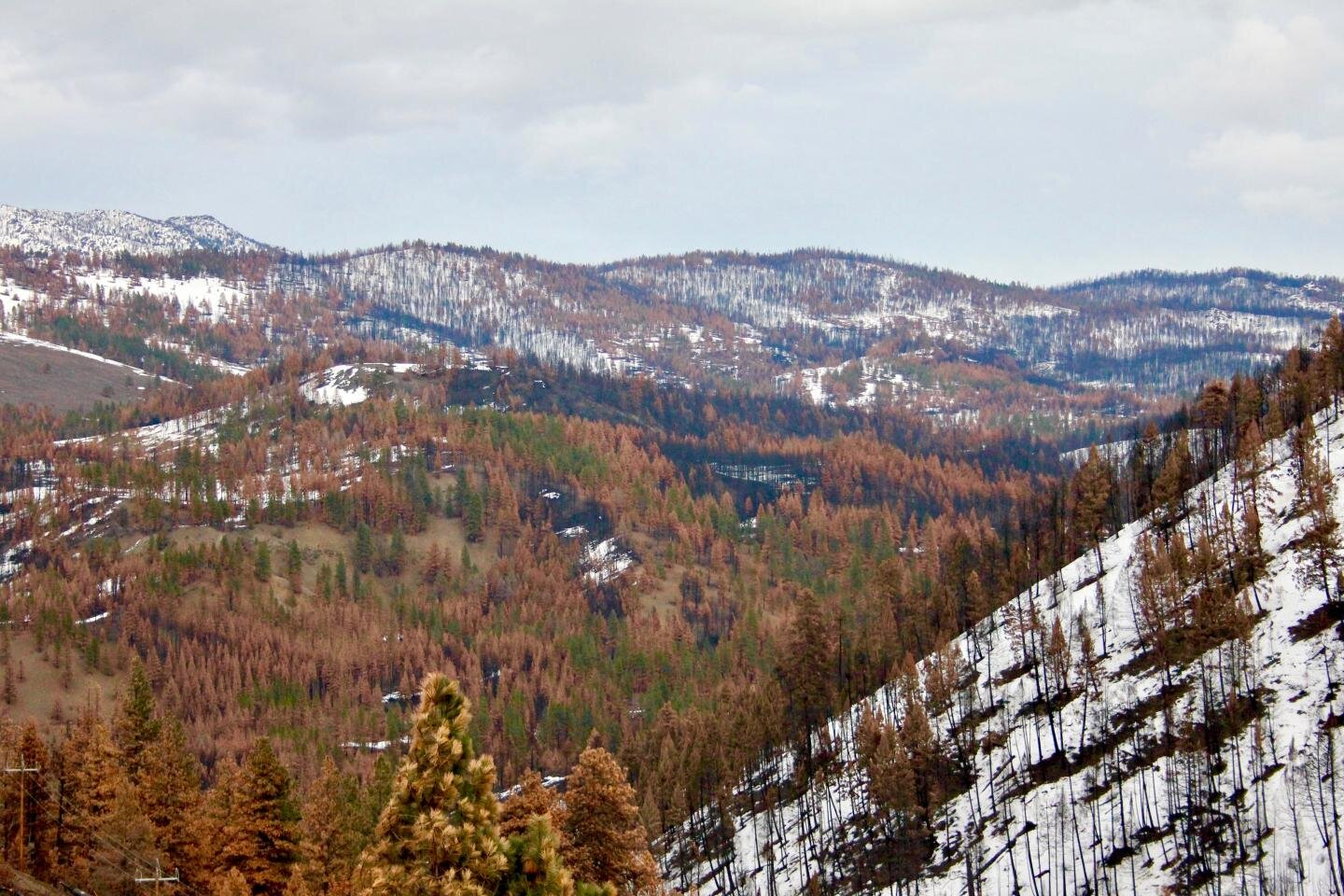
Under a warming climate, wildfires in Oregon's southern Blue Mountains will become more frequent, more extensive and more severe, according to a new Portland State University-led study.
Researchers from PSU, North Carolina State University, University of New Mexico and the U.S. Forest Service looked at how climate-driven changes in forest dynamics and wildfire activity will affect the landscape through the year 2100.
Their findings:
Even if the climate stopped warming now, high-elevation species such as whitebark pine, Engelmann spruce and sub-alpine fir will be largely replaced by more climate- and fire-resilient species like ponderosa pine and Douglas fir by the end of the century.
A growing population of shade-loving grand fir that has been expanding in the understory of the forest was also projected to increase, even under hotter and drier future climate conditions, which provided fuels that helped spread wildfires and made fires even more severe.
New lab publication in Landscape Ecology
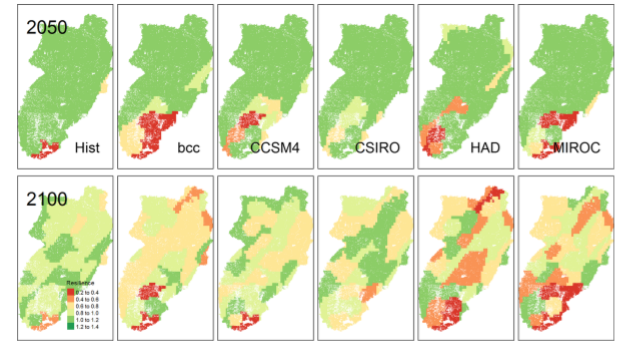
Complex interactions among successional trajectories and climate govern spatial resilience after severe windstorms in central Wisconsin, USA
Melissa S. Lucash, Kelsey L. Ruckert, Robert E. Nicholas, Robert M. Scheller, and Erica A. H. Smithwick
Landscape Ecology 34: 2897. doi.org/10.1007/s10980-019-00929-1
Resilience is a concept central to the field of ecology, but our understanding of resilience is not sufficient to predict when and where large changes in species composition might occur following disturbances, particularly under climate change. We used a spatially-explicit, forest simulation model (LANDIS-II) to simulate how windstorms and climate change affect forest succession and used boosted regression tree analysis to isolate the important drivers of resilience.
Our results illustrate substantial spatial patterns of resilience at landscape scales, while documenting the potential for overall declines in resilience through time. Species diversity and windstorm size were far more important than temperature and soil moisture in driving long term trends in resilience. Finally, our research highlights the utility of using machine learning (e.g., boosted regression trees) to discern the underlying mechanisms of landscape-scale processes when using complex spatially-interactive and non-deterministic simulation models.
New lab member!
Jannike Allen just joined our lab so she can do her Honor’s thesis on post-fire recovery in Interior Alaska.
Welcome Jannike!