Complex interactions among successional trajectories and climate govern spatial resilience after severe windstorms in central Wisconsin, USA
Melissa S. Lucash, Kelsey L. Ruckert, Robert E. Nicholas, Robert M. Scheller, and Erica A. H. Smithwick
Landscape Ecology 34: 2897. doi.org/10.1007/s10980-019-00929-1
Resilience is a concept central to the field of ecology, but our understanding of resilience is not sufficient to predict when and where large changes in species composition might occur following disturbances, particularly under climate change. We used a spatially-explicit, forest simulation model (LANDIS-II) to simulate how windstorms and climate change affect forest succession and used boosted regression tree analysis to isolate the important drivers of resilience.
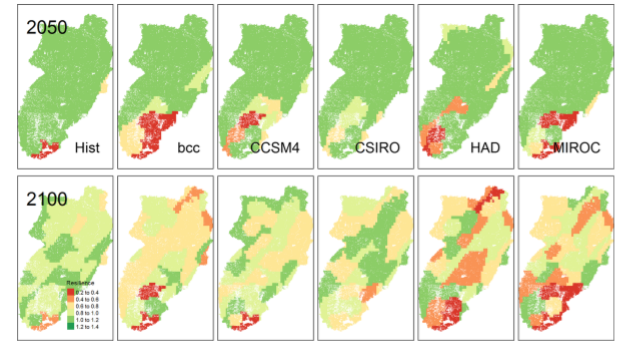
Our results illustrate substantial spatial patterns of resilience at landscape scales, while documenting the potential for overall declines in resilience through time. Species diversity and windstorm size were far more important than temperature and soil moisture in driving long term trends in resilience. Finally, our research highlights the utility of using machine learning (e.g., boosted regression trees) to discern the underlying mechanisms of landscape-scale processes when using complex spatially-interactive and non-deterministic simulation models.