Reproduction of boreal trees
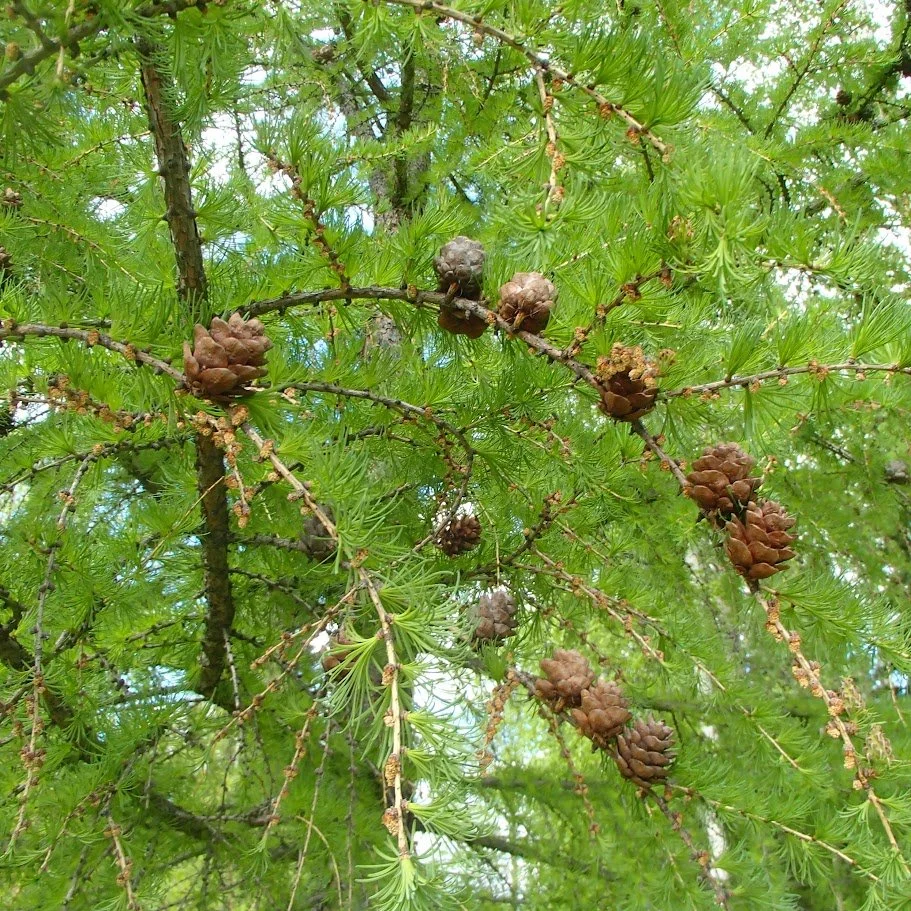
Larch cones outside Fairbanks, Alaska
The North American boreal forest comprises 16% of the world's total forested area and accounts for at least 10% of the global carbon sink. In comparison to other biomes, boreal ecosystems are impacted by agents of global change at an accelerated rate. These forcings may interact unevenly across space and over time to differentially affect reproductive processes of coniferous species which dominate the boreal biome. Understanding the influence of these global change agents on regeneration across space is a vital step in accurately modeling future boreal forest composition and extent, yet this topic is undercharacterized by existing research.
Our project team (Jalene Montagne, Missouri Botanical Garden; Beth Lawrence, UConn; Melissa Lucash and Tabytha Clearwater, UO) will track how changes in temperature, atmospheric CO₂, hydrologic regime, wildfires, and nitrogen availability alter the reproductive output of five tree species. We will:
Use herbaria to identify and link historical variability in seed production to patterns of global change across North America
Relate current global change drivers to contemporary variation in reproductive characteristics
Test the impact of projected climate scenarios on reproductive output
Use LANDIS-II to model future landscape conditions in four sites spanning the Alaska Boreal Interior, Taiga Plain, and Mixed Wood Plains ecoregions
This research will shed light on boreal tree reproduction and seed viability under dynamic climate conditions, improve the capacity of LANDIS-II to forecast regeneration shifts, and ultimately bolster agency response to local ecosystem impacts of changing climate. In the process, we will engage in ethical and effective scientific communication to diverse audiences, contribute to public biodiversity collections, and support the Bonanza Creek LTER Leaders in Training program for Native Alaskan high school students through program mentorship.
Tabytha Clearwater (Ph.D. student) and Melissa Lucash
Funded by NSF, 2025-2029